Adaptive Turbomachinery Seals for
Lower Leakage and Greater Reliability
Pi Seal is developing next-generation adaptive sealing technology that enables tighter operating clearances while remaining tolerant to vibration, thermal growth, pressure loading and rapid transient events.
About Pi-Seal
Engineering the Next Generation of Turbomachinery Sealing
Pi Seal is a University of Cambridge spin-out developing adaptive sealing solutions for high-performance turbomachinery.
Developed in response to real-world industrial challenges, Pi Seal’s technology is designed to reduce leakage while maintaining operational robustness in demanding environments.
By enabling tighter effective clearances while accommodating rotor-stator movement, Pi Seal aims to improve efficiency, reliability and availability across a wide range of industrial applications.
The Industry Challenge
Conventional Seals Force a Compromise
Engineers optimise sealing systems to achieve the best balance between efficiency and operational reliability.
Tighter Clearances
✅ Lower leakage
✅ Improved efficiency
⚠️ Increased wear risk and dynamic forcing on rotor

Larger Clearances
✅ Improved operational robustness
⚠️ Greater leakage
⚠️ Reduced efficiency
As industrial systems face increasing demands for performance, reliability and sustainability, this compromise becomes increasingly difficult to accept.
Delivering Efficiency Without Compromise
Pi Seal introduces a pressure-balanced, self-adjusting sealing concept designed to maintain tighter effective clearances while accommodating relative movement between rotating and stationary components.
The wear-free, contactless design helps reduce leakage while maintaining operational robustness, supporting improved efficiency, reliability and equipment availability.
Experimental Results
Laboratory Prototype Validation
Pi-Seal has been experimentally demonstrated on a dedicated laboratory test rig, validating the adaptive sealing concept under representative pressure loading and axial displacement.
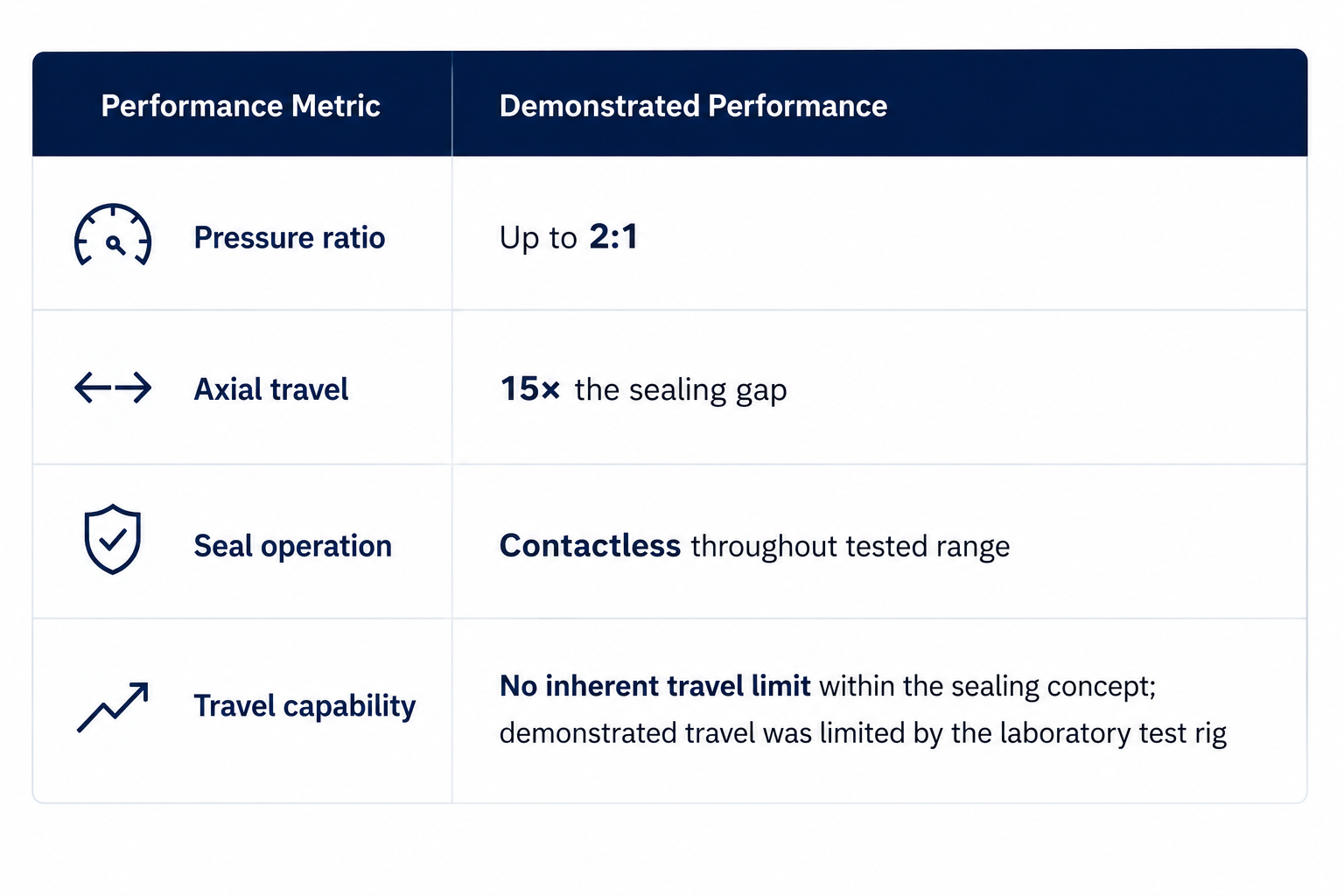
The successful prototype demonstrates that Pi-seal maintains stable, contactless operation over axial movements far exceeding conventional sealing clearances, providing strong experimental evidence for the adaptive sealing concept.
Key Benefits
Lower Leakage
Up to 90% reduced leakage for conventional labyrinth applications.
Improved Reliability
Tolerant to vibration, rotor off-centring and rapid transients. No dynamic forcing on the rotor.
Wear-Free Operation
Contactless sealing helps minimise wear and performance degradation.
Greater Availability
Support long-term operational performance across demanding industrial environments.
Applications
Pi-Seal technology has potential applications across a range of turbomachinery and industrial sectors where efficiency, reliability and operational performance are critical.
Gas Turbines
Improve efficiency and reliability in demanding operating environments.
Compressors
Reduce leakage and support long-term machine performance.
LNG & Industrial Gases
Support reliable operation across critical gas processing systems.
Hydrogen Systems
Enable advanced sealing solutions for emerging energy technologies.
Surveys
Share your experience and help us better understand the sealing challenges, technical requirements and operational priorities across turbomachinery applications. Select the survey most relevant to your role and expertise below.
Sealing Challenges &
Market Validation
Technical Application
& Validation
Operational &
Overhaul Challenges
INTERESTED IN LEARNING MORE?
Let’s Explore the Possibilities Together
We are engaging with manufacturers, operators and development partners to explore future applications of Pi-Seal technology.
✔ Discuss partnership opportunities
✔ Explore pilot projects
✔ Learn more about the technology
Contact Us